

Planexa: demand-to-supply planning
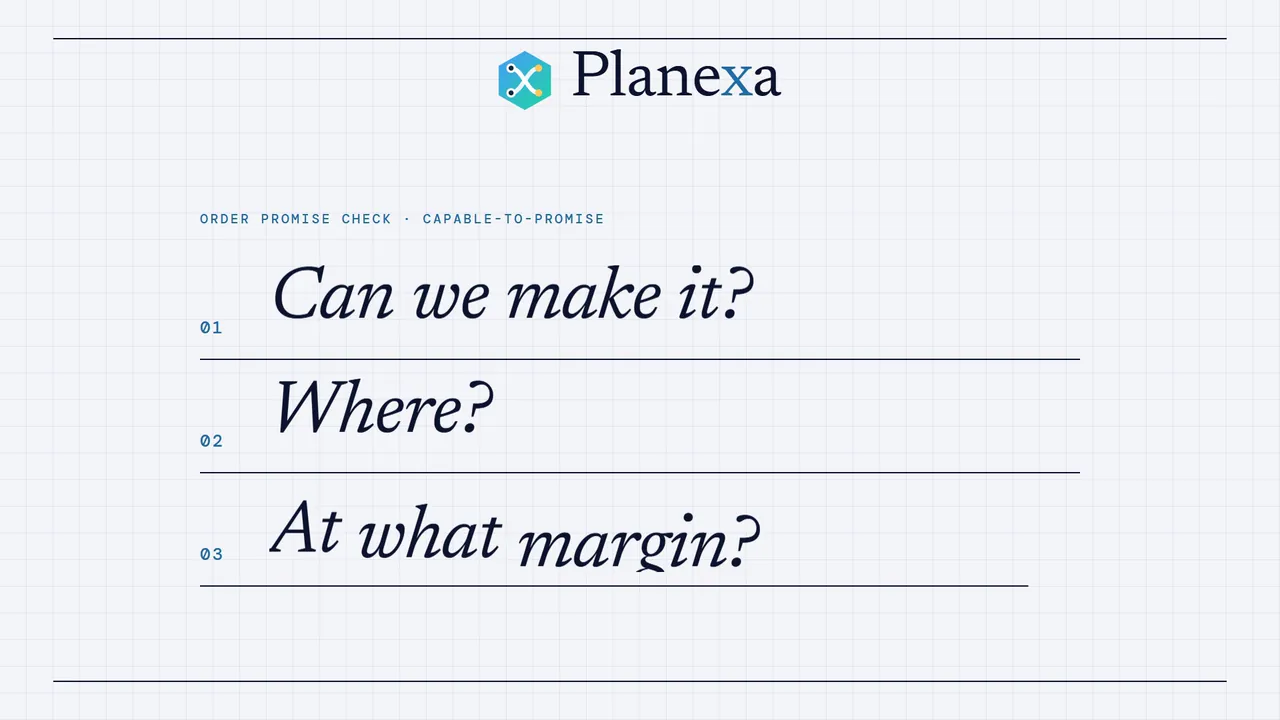
Planexa answers the question sales keeps asking: can we make it, where, and at what margin? It plans your whole demand book on finite capacity across every plant, checks new orders against what is left, and turns shortfalls into purchase requisitions.
Watch Planexa at work
A two-minute film showing Planexa checking a 4,000-roll order against capacity and materials across three plants, recommending the line that makes the date and showing the margin.
- Can we make it?
- Meet Planexa
- Enter the order once
- Every line tested
- The answer and the margin
- The whole demand book
- Cockpit and requisitions
- Compare scenarios
- Every rule in one place
Read the film transcript
4,000 rolls. Needed by the fourteenth of November.
Sales needs an answer. Can we make it?
Usually, that answer means spreadsheets, calls to three plants, and a promise built on hope.
Meet Planexa, by Proctel. It answers the question properly: can we make it, where, and at what margin?
Enter the order once: customer, product, quantity, and the date it's needed.
Before it plans anything, Planexa checks the master data is ready.
Then it works through ten planning steps, from stock and capability to materials, capacity, labour, cost and delivery.
Every line in every plant is tested. Nine lines. Six don't have the technology. Three can run it.
The cheapest line would land four days late. So Planexa recommends the one that makes the date.
Frontier Process Works, Line 11. On time, the fourteenth of November.
Landed cost: $494,000. Gross margin: 50.6 percent.
And it shows its working: every weight, every score, and exactly why this line won.
Every component is already in stock, above safety level.
But no order stands alone. Planexa plans your whole demand book: firm orders, forecast and pipeline, across every plant, week by week, on finite capacity.
Euros, yen, rupees. Rolls, boxes, square metres. All normalised into one plan.
The cockpit shows where lines run hot, which orders are at risk, and what to do next.
Shortfalls become purchase requisitions, sized to order minimums and timed to supplier lead times.
Change the intent: cost first, capacity first, delivery first. And compare the outcomes side by side.
Every rule lives in one place: plants, lines, bills of material, calendars, freight lanes. And every change lands in the audit trail.
Promise what you can make. Make what you promise.
Planexa. Demand-to-supply planning, by Proctel.
Check an order promise before you make it
Capable-to-promise: a date based on free capacity and materials, not just stock.
Enter the order once
Customer, product, quantity, unit, price and the date it is needed.
Check the data is ready
Product master, released bill of materials, costed components, capable lines, freight lane, exchange rate and labour calendar.
Test every line
Each line in each plant is checked for technology, specification, material, capacity and labour.
Recommend the line
Capable lines are scored with your scenario weights; the cheapest line loses if it would land late.
Show the margin
Landed cost from material, labour, machine, energy, overhead and freight, and the gross margin that follows.
Show the working
Every weight, every score and exactly why this line won, with a full calculation trace.
Plan the whole demand book
No order stands alone. Planexa plans firm orders, forecast and pipeline together.
- Firm orders before forecast before pipeline, with opportunities weighted by win probability.
- Finite weekly capacity by line and labour, after maintenance and existing commitments.
- Material requirements from the bill of materials, using stock above safety level first.
- Shortfalls become purchase requisitions, sized to order minimums and lot multiples and timed to supplier lead times.
- Currencies and units of measure normalised into one plan: euros, yen, rupees, rolls, boxes, square metres.
- A cockpit that shows where lines run hot, which orders are at risk and what to do next.
Compare planning intents side by side
Change the intent and the whole plan re-runs with its own scoring weights.
Cost first
Prefers the line with the lowest landed unit cost while keeping promises in tolerance.
Capacity first
Protects headroom on busy lines and spreads load across plants.
Delivery first
Favours on-time delivery, splitting late orders across lines where rules allow.
Each scenario reports on-time count and value, late or unplanned demand, plan cost, gross margin, requisitions and average utilisation.
Every rule lives in one place
Master data and planning policies are validated, cross-checked and written to the audit trail on every change.
What Planexa does today, and what deployment adds
We would rather you know the scope before the demo.
Today
- Plans in weekly buckets, like a master production schedule.
- One production stage per product; multi-level bills of material are on the roadmap.
- Formula and scoring based: no AI, and every number can be traced.
In a deployment
- Sales orders, forecasts, inventory, bills of material and routings from your ERP through APIs or scheduled extracts, with planned orders and requisitions written back.
- Single sign-on, role-based access and versioned plans.
Questions about Planexa
What is demand-to-supply planning?
Demand-to-supply planning matches what customers want with what your plants and suppliers can deliver. It takes firm orders, forecasts and pipeline, plans them against finite capacity and materials, and shows where supply will fall short.
What is capable-to-promise (CTP)?
Capable-to-promise gives a delivery date based on free capacity and available materials, not only on finished stock. Planexa checks a new order against what is left after the current demand book is planned.
Does Planexa replace our ERP's planning?
Planexa plans across plants and shows its working; your ERP stays the system of record. In a deployment, orders, inventory and bills of material come in from the ERP and planned orders and requisitions go back.
Does Planexa use AI?
No. Planexa uses transparent formulas and scoring weights you can see and change. Every recommendation comes with a calculation trace.
More on Planexa
Test Planexa on an order you are quoting now
Book a demo and bring a real order: we will show where it can be made, when, and at what margin.