
Fulcrum: eSourcing from demand to signed contract
Fulcrum is Proctel's eSourcing platform. Specialist agents draft the scope, estimate should-cost, build the RFx from your clause library, weigh the bids and prepare the negotiation, while your approvers sign off every gate.
Watch Fulcrum at work
A two-and-a-half-minute film showing Fulcrum's agents drafting scope, estimating should-cost, building the RFx, weighing bids and preparing the negotiation while people approve every gate.
- Why sourcing stalls
- Meet Fulcrum
- Eight specialist agents
- Scope and should-cost
- RFx from your clause library
- Best-value bid analysis
- The negotiation plan
- Approvals and audit trail
- Award to contract
Read the film transcript
Twelve steps. Six approvers. One sourcing event, and most of it still runs on spreadsheets and email.
Weeks of drafting. Quotes compared by hand. Savings no one can trace.
Meet Fulcrum, by Proctel. AI agents that run the whole sourcing cycle, from demand to signed contract, while your team keeps every decision.
One workbench for every event in flight: the pipeline, the savings, and exactly what's waiting on you.
Behind it, eight specialist agents. Requirements. Market intel. Template. Reviewer. Negotiation. Bid analysis. Strategy. Contract. Each one hands its work to the next.
Describe the need once. The requirements agent drafts the scope, event type, requirements, service levels and weighted criteria.
The market agent triangulates a should-cost, sizes the realistic range, and places the category on the Kraljic matrix, before a single supplier is invited.
Then it ranks your supplier master on fit, performance and risk, and tells you how confident it is.
The template agent assembles the RFx from your approved clause library, legal text is never invented, and the reviewer scores it before release.
When the bids land, the lowest price isn't automatically the winner. Fulcrum weighs cost, quality, delivery, terms and risk into one best-value index.
For the negotiation, it sets your opening, target and walk-away, names your best alternative, and ranks the levers beyond price.
And nothing moves without people. Scope, mandate and award each wait for the right approvers, and every action lands in the audit trail.
Underneath sit your own playbooks, clause library and approval rules. Run it on rules alone, or add Claude for richer drafting.
Award a primary and a standby. The contract agent drafts the agreement from the award and the negotiated terms, ready for legal review.
And every rupee of saving is traced, from the historical baseline to the final price.
Twelve steps. Eight agents. And every decision still yours.
Fulcrum, by Proctel. Connecting systems. Optimizing outcomes.
One workbench for every sourcing event
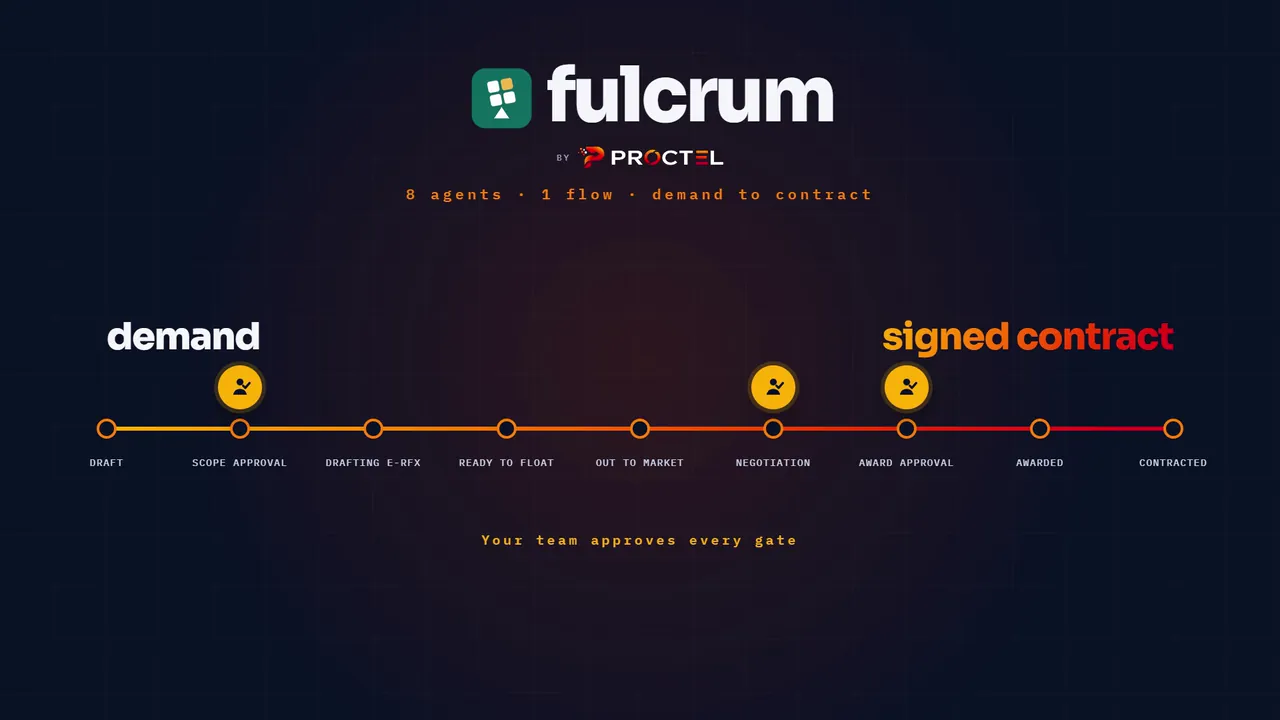
Fulcrum follows a sourcing event through every stage and shows what is waiting on whom.
Demand
Describe the need once: category, value, timing and what good looks like.
Scope
The requirements agent drafts event type, requirements, service levels and weighted criteria.
Market and strategy
Should-cost, a realistic price range and the category's place on the Kraljic matrix.
Suppliers
Your supplier master ranked on fit, performance and risk, with a stated confidence.
e-RFx
The RFx assembled from your approved clause library and scored before release.
Bids
Responses collected per invited supplier, or entered by your team.
Bid analysis
Cost, quality, delivery, terms and risk weighed into one best-value index.
Negotiation
Opening, target and walk-away positions, your best alternative and the levers beyond price.
Award
A primary and a standby supplier, approved by the right people.
Contract
An agreement drafted from the award and the negotiated terms, ready for legal review.
Eight agents, one hand-off chain
Each agent reads the event and your data, does one job and passes its work on.
Requirements agent
Turns the demand into a scope: event type, requirements, service levels and weighted evaluation criteria.
Market intelligence agent
Triangulates a should-cost, sizes the realistic range, places the category on the Kraljic matrix and recommends suppliers.
Template agent
Assembles the RFx from your approved clause library. It fills placeholders and never writes legal text.
Reviewer agent
Checks the draft against policy, scope, market and clauses, and scores it for release readiness.
Negotiation agent
Recommends a bidding method from reverse auctions, sealed bids, multi-attribute and multi-round options.
Bid analysis agent
Normalises offers and ranks them on a best-value index, so the lowest price is not automatically the winner.
Negotiation strategy agent
Builds the playbook from the actual offers: opening, target, walk-away and the levers beyond price.
Contract preparation agent
Drafts the agreement from the award and the negotiated terms for legal review.
People decide. Fulcrum keeps the record.
Nothing moves past a gate without the right approvers.
- Scope, negotiation mandate and award each wait for their approvers: category manager, head of procurement, legal, finance and CFO as your rules require.
- Every agent output, edit and approval lands in the audit trail, newest first.
- Your playbooks, clause library, approval thresholds and policy rules sit underneath every event.
- Agents run on a rules engine by default. An optional language-model engine can add richer drafting.
- Every saving is traced from the historical baseline to the final price.
Built for the categories you buy
Playbooks carry requirements, service levels, criteria, cost structure and market parameters for each category.
Category playbooks
Bidding and auction methods
Contract terms by jurisdiction
Questions about Fulcrum
What is an eSourcing platform?
An eSourcing platform runs the sourcing part of procurement online: defining the need, inviting suppliers, issuing RFIs, RFPs and RFQs, running auctions, evaluating bids and awarding the contract. It replaces spreadsheets and email threads with one record of every decision.
What does Fulcrum cover, and what does it leave to other systems?
Fulcrum covers sourcing from demand to signed contract. Purchase orders, invoices and payments stay in your procure-to-pay or ERP system. Proctel's enterprise application teams work with Coupa, SAP and Ivalua if you need the two connected.
Does Fulcrum use AI?
Fulcrum's agents run on a rules engine by default, using your playbooks, clause library and approval rules. You can add a language-model engine for richer drafting. Legal text always comes from your approved clause library.
Can Proctel run sourcing events for us on Fulcrum?
Yes. Our eSourcing services team prepares, runs and evaluates events with you, on Fulcrum or on the sourcing suite you already use.
More on Fulcrum
See Fulcrum run one of your sourcing events
Book a demo and we will walk through an event in a category you buy, from demand to contract.