

Invexa: inventory intelligence for every plant
Invexa keeps each plant's stock just right: never so little that a line stops, never so much that cash sits idle and batches expire. Every morning its agents check every item, draft requisitions sized to your policy and route them to the right people. Agents draft; people decide.
Watch Invexa at work
A three-minute film following Invexa through two plants: agents check every item each morning, draft requisitions and route them to people, from the control tower to the audit trail.
Open the film page- Too little, too much
- Meet Invexa
- One control tower
- Eight agents, every morning
- Alerts, items and the order
- Expiry, receiving and counts
- Replenish or transfer
- People approve, on record
- Services and suppliers
- What-if, Ask Invexa and analytics
- One versioned policy
- Just right
Read the film transcript
A critical spare runs out, and a production line stops.
Next door, cash sits in excess stock, and batches expire unused.
Too little stops the plant. Too much expires on the shelf.
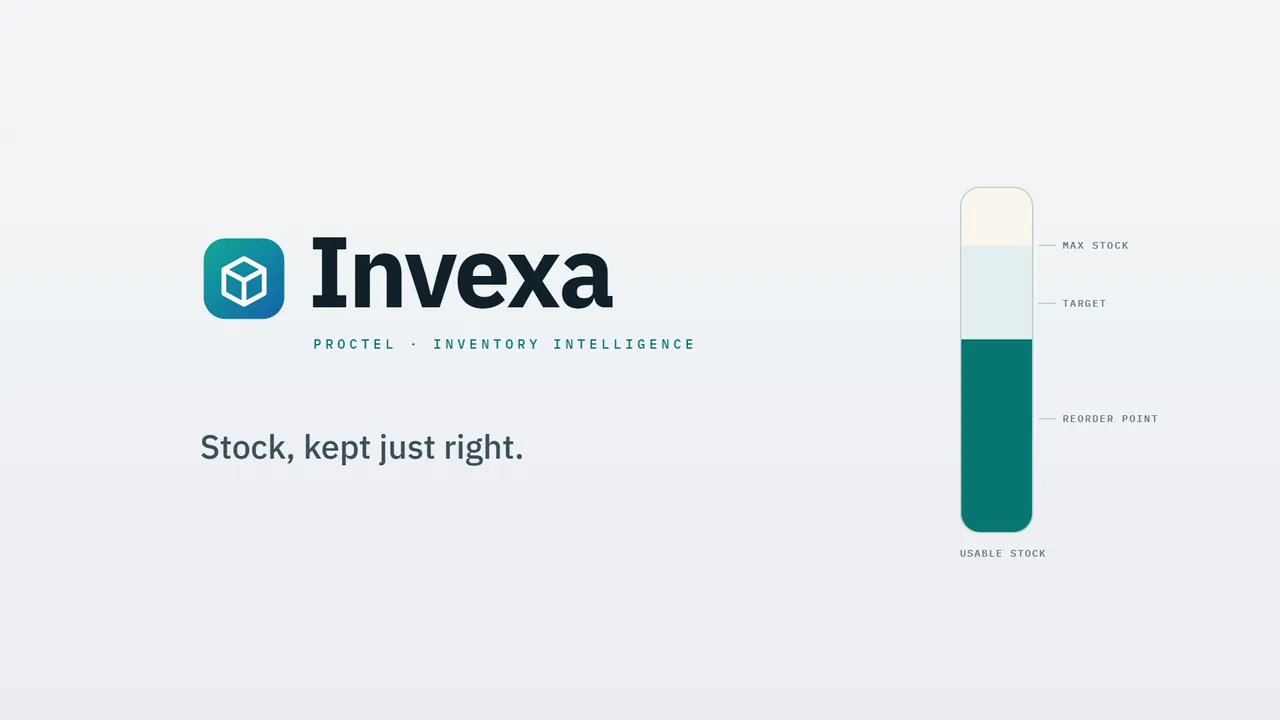
Invexa. Proctel inventory intelligence. Stock, kept just right.
One control tower shows both plants: every risk, and every order, from recommendation to delivery.
Every morning, eight agents run the cycle. Monitoring reads the ERP snapshot and holds any item whose data it can't trust. Forecasting, expiry and supplier risk look ahead; replenishment drafts requisitions, and workflow routes them. Nothing is committed without a person.
Every finding becomes an alert, graded by severity, and bad master data is quarantined until it's fixed.
Each item gets one page: stock, usage, cover and risk. Demand is cleaned of outliers, then forecast, and every recommendation states its confidence.
When usable stock reaches the reorder point, Invexa drafts an order up to target, less usable stock and open orders, rounded to the supplier's lot.
Batches issue first-expiry, first-out. Expired, inspection and reserved stock is never issued, and a calendar flags what expires next.
Every stock movement is validated before it posts to the ERP.
Deliveries are received against the order, and chemicals wait in quality inspection until released.
Every bin and batch is tracked with its value, expiry and age.
Cycle counts follow ABC frequency; small variances post automatically, larger ones wait for the Plant Head.
The replenishment worksheet skips anything already in approval, so nothing is ordered twice.
Before buying, it checks the other plant for surplus. A transfer, not a purchase.
Every draft goes to people. An approver can change the quantity, with a reason code.
The approval matrix routes each draft by value, from the Planner Lead up to the CFO. Emergencies fast-track, and missed deadlines escalate.
Both quantities stay on a tamper-evident record. Repeated changes trigger a review, never an automatic rule change.
Service contracts are planned on their remaining balance, and topped up before the hours run out.
Supplier risk tracks on-time delivery, lead-time drift and single sources. Items with no catalogue entry go to Sourcing.
What-if tests a change, like a longer lead time, before anyone commits to it.
And anyone can ask in plain language. Every answer comes from platform records, with its sources.
Analytics track service, turns, cover, excess and forecast accuracy, with every report exported in a click.
Every rule lives in one versioned policy, and changes only through an approved request.
And the solution blueprint documents the architecture, agents, formulae and security behind it.
Never too little. Never too much. Agents draft, people decide. Just right.
Invexa. By Proctel.
How a replenishment decision is made
From the morning's ERP snapshot to an approved requisition, every step is visible.
Read the ERP snapshot
Stock, open supply and batches come in each morning. Any item whose master data fails the data-quality check is held, not guessed.
Clean and forecast demand
Usage is cleaned of outliers, then forecast with the method that suits the item's demand pattern, and accuracy is measured on held-back history.
Check the reorder point
When stock, counting what is already on order, reaches the reorder point, the item needs an order.
Size the order
Up to target, less usable stock and open orders, rounded to the supplier's lot and capped by maximum stock, storage room and shelf life.
Look before buying
If the other plant holds surplus of the same material, Invexa suggests a transfer instead of a purchase.
Draft and route
The requisition goes to the right approvers with its justification and a stated confidence. Anything already in approval is skipped, so nothing is ordered twice.
Decide and record
Approvers can change the quantity with a reason code. Both quantities stay on a tamper-evident decision record.
Eight agents, each with fixed permissions
Agents reason and route. Every number comes from the calculation engines, and your policy gates every step.
Supervisor
Runs the agents in sequence, resolves conflicts and enforces time limits, step budgets and escalation.
Monitoring agent
Scans stock, open supply and expiry against policy and runs the data-quality gate. Read-only.
Forecasting agent
Chooses the forecasting method by demand pattern, measures accuracy and bias, and flags forecasts that deteriorate.
Classification agent
Recalculates ABC, XYZ and movement classes and proposes criticality changes with evidence. It never edits master data.
Replenishment agent
Checks duplicates, policy and stock at the other plant, then drafts the requisition and its justification.
Expiry and issue agent
Plans first-expiry-first-out issues and near-expiry actions: use first, transfer, return or dispose.
Supplier risk agent
Watches single sources, concentration, on-time delivery and lead-time drift, and ranks alternatives.
Approval and workflow agent
Routes drafts by the approval matrix, sends reminders and escalates missed deadlines. It never releases a purchase order.
Agents never release purchase orders or post stock. People do, and only a released purchase order commits spend.
Everything the storeroom does, in one place
Stock is only as good as the record behind it, so Invexa runs the daily work as well as the planning.
- Stock operations: issue, receive, release, reserve, transfer, move, scrap or return, each validated before it posts to the ERP.
- Receiving against the order, with chemicals and lab reagents held in quality inspection until they are released.
- Warehouse and bins: every bin and batch with its value, expiry and age.
- Cycle counting by ABC frequency. Small variances post automatically; larger ones wait for the Plant Head.
- Expiry and ageing: expired, inspection and reserved stock is never issued, a calendar shows what expires next, and the slow-moving provision is calculated.
- Services and contracts planned on their remaining balance and burn rate, with top-ups raised before the hours run out.
- Suppliers tracked for on-time delivery, lead-time drift and single sources. Items with no catalogue entry go to sourcing as an RFQ package.
Ask, test and measure
Questions answered from the records, changes tested before anyone commits, and the measures that matter.
Ask Invexa
Ask in plain language: which critical items will run out, what is near expiry, why an order was recommended. Every answer comes from platform records and lists its sources.
What-if simulator
Change demand, lead time, service level or order rules and watch safety stock, reorder point and stock-out chance move. Live data and policy stay untouched.
Analytics and reports
Service level, stock-out rate, supplier on-time-in-full, inventory turns, days of cover, excess and non-moving value and forecast accuracy, with reports to export.
Governed by one versioned policy
Every threshold the engines and agents use lives in one place, and changes only through an approved request.
- An approval matrix routes each draft by value and type, from the Planner Lead to the CFO, with deadlines, reminders and escalation.
- Emergencies fast-track when a critical item would run out before the supplier can deliver.
- An append-only, hash-chained audit trail records every agent decision, human action and posting.
- Repeated changes by approvers trigger a review, never an automatic rule change.
- A dry run validates movements without posting them, and a kill switch blocks posting to the ERP.
What Invexa does today, and what deployment adds
We would rather you know the scope before the demo.
Today
- Runs a daily cycle on an ERP snapshot, with event triggers in between.
- Service levels, cover days and approval limits are set with you; the figures in the film are examples.
- A language model helps with explanations, conflict summaries and reading supplier notes. Every quantity, date and value comes from the calculation engines.
In a deployment
- SAP S/4HANA first, through its standard APIs with file fallbacks: a daily snapshot plus near-real-time goods movements and order changes.
- Single sign-on with multi-factor authentication, and roles scoped by plant and category.
- Hosted in your own cloud tenant and region, with least-privilege ERP access.
- Document currencies with daily exchange rates.
Questions about Invexa
What is inventory optimisation?
Inventory optimisation means holding enough of each item to meet demand at the service level you choose, without excess that ties up cash or expires. It sets safety stock, reorder points and order sizes for every item from its usage, lead time and criticality, and keeps them current as those change.
Does Invexa place orders on its own?
No. Invexa's agents draft requisitions and route them to your approvers. People approve them, and only a released purchase order commits spend. Agents can never release purchase orders or post stock.
Does Invexa use AI?
Invexa's agents reason about what needs attention and route the work, and a language model helps write explanations, summarise conflicts and read supplier notes. Every quantity, date and value comes from deterministic calculation engines applying your policy, so each number can be traced.
Does Invexa replace our ERP?
No. Your ERP stays the system of record. Invexa reads its data, validates stock movements before they post, and hands approved requisitions back to the ERP.
More on Invexa
See Invexa on stock like yours
Book a demo and we will walk through a morning's cycle, from the first alert to an approved requisition.